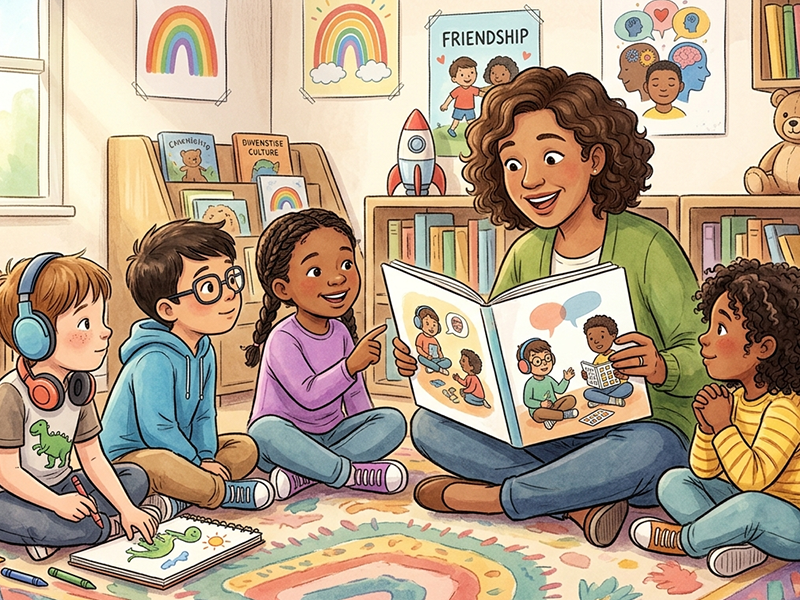
There’s a moment every parent or teacher eventually runs into. A child notices something different. Maybe another child covers their ears during loud noises. Maybe they don’t make eye contact. Maybe they prefer to play alone. And then comes the question:
“Why are they like that?”
You could answer with definitions. You could try to explain brain wiring or sensory processing. But let’s be honest, that rarely lands with a young child. This is where storytelling quietly does something powerful. When you’re figuring out how to teach kids about autism spectrum disorder, stories often work better than explanations ever will.
Why Storytelling Works So Well
Children don’t learn through lectures. They learn through connection. A good story doesn’t say, “Here’s what autism is.” It says, “Here’s a person. Here’s how they feel. You might feel that way, too.”
And suddenly, it clicks. Instead of seeing someone as “different,” kids start recognizing shared experiences. Fear. Excitement. Curiosity. Wanting a friend.
That emotional bridge matters more than any textbook definition.
Start with What Kids Already Understand
One of the simplest ways to teach kids about autism is to begin with familiar ground. Think about everyday moments:
- Falling and scraping a knee
- Feeling scared at night
- Wanting to play with someone but not knowing how to ask
These are universal. Every child gets this. The book Just Like You: Tim’s Story by Terri Geerinck leans into this beautifully.
It doesn’t open with labels or differences. It starts with Tim talking about things he enjoys. Playing, exploring, eating sweets and spending time with family.
A child reading it doesn’t think, “This is about autism.” They think, “This is about someone like me.” That’s the hook.
Gently Introduce Differences Without Making Them the Focus
Once that connection is there, you can begin to layer in differences. But softly. Not as something strange. Not as something to fix. Just as part of how someone experiences the world.
In Tim’s story, moments of sensory overwhelm appear naturally. Loud noises feel too intense. Big crowds can be uncomfortable. Sometimes he needs quiet.
No dramatic language. No heavy framing. Just honesty. And then it circles back again and again to something simple and grounding: “I’m just like you.”
That repetition matters. It reassures children that differences don’t erase similarity.
Let Kids See Themselves in the Story
Here’s something many adults overlook: children don’t just learn about others through stories. They learn about themselves. When you teach kids about autism spectrum disorder through storytelling, you’re also giving them language for their own feelings.
A child might not be autistic, but they might still:
- Get overwhelmed in noisy places
- Feel shy in groups
- Need time alone
So, when they see those traits in a character, something shifts. Instead of thinking, “That’s different,” they think, “Wait… I do that too.” That’s empathy in its most natural form. No forcing required.
Turn the Story into a Conversation
Reading is just the starting point. The real magic happens after. Ask simple questions:
- “What did Tim like that you like too?”
- “Have you ever felt scared like that?”
- “What would you do if Tim were your friend?”
You don’t need perfect answers. Kids don’t need perfect answers. They just need space to think, to respond, to connect. Geerinck’s book actually builds this in through its teacher’s notes and activities.
Drawing, role-playing, imagining scenarios. It turns the story into something active, not passive. And that’s where understanding really sticks.
Focus on Friendship, Not Just Awareness
A lot of conversations about autism stop at awareness. But awareness alone doesn’t change behavior. Kids don’t just need to know. They need to feel comfortable engaging.
So instead of ending with “This is autism,” shift the focus slightly: “How can we be a good friend?” That might look like:
- Giving someone space when they feel overwhelmed
- Choosing quieter activities
- Being patient during play
These are small things. But for a child, they’re everything.
Keep It Simple. Keep It Human.
If you’re wondering how to teach kids about autism in a way that actually sticks, the answer isn’t complicated. Don’t over-explain. Don’t overcorrect.
Just show them a person. Let them relate. Let them ask questions. Stories like Just Like You: Tim’s Story work because they don’t try too hard. They trust that children are already capable of understanding kindness, connection, and difference when it’s presented in a way that feels real.
And honestly, that’s the part we sometimes forget. Kids are already wired for empathy. They just need a little help seeing where to place it.
The Final Thoughts
You don’t need the perfect words to start this conversation. You just need a starting point. A story read together before bedtime. A quiet moment in a classroom. A simple question that opens the door.
When you teach kids about autism spectrum disorder through storytelling, you’re not just explaining a condition. You’re shaping how a child sees another human being. And that’s something they carry with them far beyond the page.